
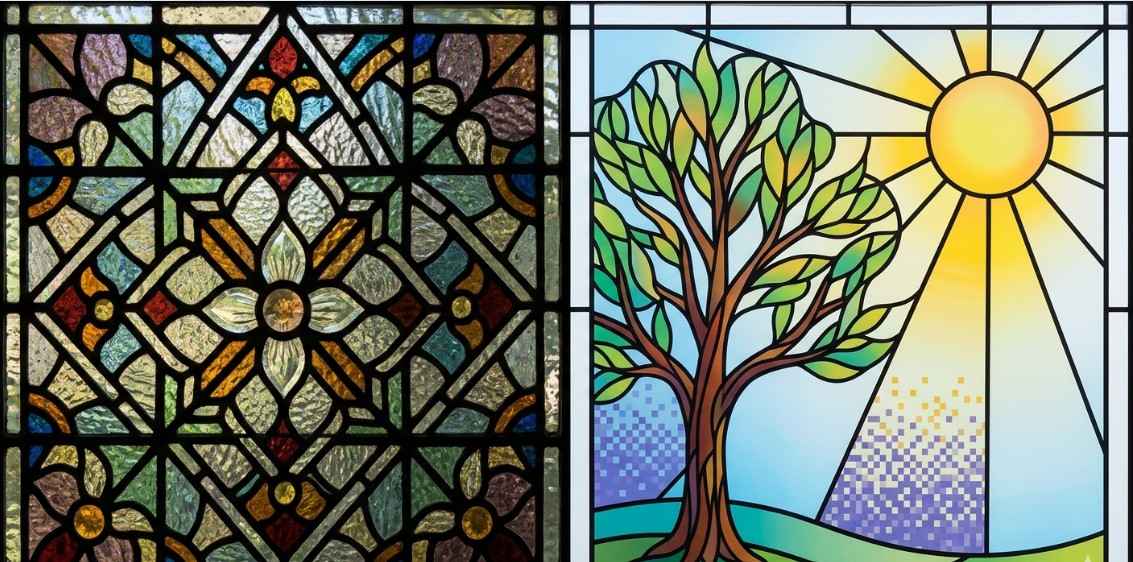
Stained glass has evolved from a centuries-old craft into a modern architectural solution used in homes, offices, and commercial spaces. Today, designers and clients often face a key choice: traditional stained glass or printed stained glass. While both serve decorative and functional purposes, they differ significantly in materials, manufacturing process, durability, cost, and visual performance.
This guide provides a professional, research-backed comparison to help architects, designers, and buyers make informed decisions.
What is Traditional Stained Glass?
Traditional stained glass is an artisanal technique that dates back to medieval Europe. It involves assembling individually colored glass pieces into a unified design using metal frameworks.
How It Is Made
The process is highly skilled and time-intensive:
- Glass is colored during manufacturing using metallic oxides
- Each piece is hand-cut according to a design template
- Pieces are joined using lead cames or copper foil
- Joints are soldered and sealed for stability
This handcrafted method results in a multi-layered, textured surface where each glass piece interacts uniquely with light.
Key Characteristics
- Rich, deep colors embedded within the glass
- Visible lead lines forming part of the design
- Natural variation in texture and thickness
- Strong artistic and historical value
Traditional stained glass is widely used in heritage buildings, luxury homes, and bespoke architectural projects, especially when clients are looking for highly customized artistic elements that align with premium stained glass & painting services designed for long-term aesthetic value.
What is Printed Stained Glass?
Printed stained glass, often referred to as digitally printed or ceramic-frit glass, is a modern innovation that replicates stained glass aesthetics using advanced technology.
How It Is Made
- A digital design is created using software
- The design is printed onto a single glass panel using ceramic inks
- The glass is heat-treated, fusing the design permanently onto the surface
Unlike traditional methods, this process does not involve assembling separate glass pieces.
Key Characteristics
- High-resolution, photo-realistic designs
- Smooth, uniform surface
- Faster production time
- Ability to replicate complex patterns with precision
Printed stained glass is commonly used in commercial interiors, modern homes, partitions, and facades, and it can also be creatively integrated into modern interiors such as bespoke glass furniture to achieve a cohesive and design-driven space with consistent visual appeal.
Core Differences Between Traditional and Printed Stained Glass
1. Fabrication Method
The most fundamental difference lies in how each type is produced.
Traditional stained glass is handcrafted by assembling multiple glass pieces, making it labor-intensive and dependent on artisan skill. In contrast, printed glass is machine-driven and digitally controlled, allowing for faster and scalable production.
2. Visual Depth and Light Interaction
Traditional stained glass offers unmatched depth because colors are embedded within the glass itself. Light passes through varying thicknesses and textures, creating a dynamic, ever-changing visual effect.
Printed glass, while visually precise, tends to appear flatter since the design sits on the surface. It lacks the same level of light refraction and dimensional richness.
3. Durability and Performance
Durability depends on application and fabrication quality:
- Traditional stained glass can last for decades or even centuries when properly maintained, although individual pieces may be more delicate.
- Printed glass, especially when tempered or laminated, offers high resistance to scratches, UV exposure, and environmental wear due to fused ceramic inks
Additionally, printed glass can be engineered to meet modern safety standards, including lamination and tempering.
4. Cost and Production Time
Traditional stained glass is significantly more expensive due to:
- Manual craftsmanship
- Longer production timelines
- Specialized labor
Printed glass is more cost-effective because it uses automated processes and requires less time to produce.
This makes printed glass a preferred option for budget-sensitive or large-scale projects.
5. Customization and Design Flexibility
Printed glass excels in customization:
- Complex graphics, logos, and photographic designs can be easily replicated
- Consistency across large panels is achievable
Traditional stained glass, while customizable, is limited by manual cutting and assembly constraints, making intricate or highly detailed designs more challenging.
Detailed Comparison Table
| Feature | Traditional Stained Glass | Printed Stained Glass |
|---|---|---|
| Manufacturing | Handcrafted glass pieces | Digital printing on single glass |
| Appearance | Deep, textured, artistic | Flat, high-resolution design |
| Light Effect | Strong refraction and glow | Soft light transmission |
| Durability | Very long-lasting (with care) | Durable when tempered |
| Cost | High | Affordable |
| Production Time | Slow | Fast |
| Customization | Artistic designs | Unlimited digital designs |
Practical Applications in Modern Architecture
Where Traditional Stained Glass Works Best
- Religious buildings and heritage restoration
- Luxury villas and high-end residences
- Feature windows and artistic installations
Its value lies in craftsmanship, authenticity, and timeless appeal.
Where Printed Stained Glass Excels
- Office partitions and commercial interiors
- Hotels, restaurants, and retail spaces
- Contemporary residential projects
It is ideal for projects requiring speed, uniformity, and modern aesthetics.
Safety Considerations
One important distinction is safety performance.
Traditional stained glass, in its classic form, is not inherently a safety glass unless combined with protective glazing.
Printed glass, however, can be manufactured as tempered or laminated safety glass, reducing the risk of injury and improving structural integrity.
This makes printed glass more suitable for high-traffic and compliance-driven environments.
Maintenance and Longevity
Traditional stained glass requires periodic maintenance:
- Lead joints may weaken over time
- Cleaning must be handled carefully to avoid damage
Printed glass, on the other hand:
- Is easier to clean due to its smooth surface
- Requires minimal maintenance
- Retains its design without fading or peeling due to fused inks
Expert Insight: Choosing the Right Option
From a professional standpoint, the decision between traditional and printed stained glass depends on project priorities:
- Choose traditional stained glass if the goal is artistic authenticity, heritage value, and unique craftsmanship
- Choose printed stained glass if the focus is cost-efficiency, scalability, and modern performance standards
In many contemporary projects, architects even combine both techniques to achieve a balance between aesthetic depth and functional efficiency.
AI Overview
Traditional vs printed stained glass explained with key differences in design, cost, durability, and light effect. Learn which option suits your space, budget, and modern or classic design needs.
FAQs
What is the difference between traditional and modern stained glass?
Traditional stained glass is handcrafted using colored glass pieces joined with lead. Modern stained glass often uses digital printing on a single glass sheet for faster production.
What is printed stained glass?
Printed stained glass is glass with designs digitally printed using ceramic or UV inks. It offers high detail, fast production, and a cost-effective alternative to traditional methods.
What are different types of stained glass?
Main types include traditional leaded glass, copper foil glass, and printed stained glass. Each type varies in craftsmanship, cost, durability, and visual depth.
How to tell if stained glass is original?
Original stained glass has visible lead lines and slight imperfections from handcrafting. It also shows depth, texture, and rich color variation when light passes through.
Conclusion
Traditional and printed stained glass each offer unique advantages based on your project needs, with traditional glass delivering craftsmanship and timeless beauty, while printed glass provides flexibility, affordability, and faster production. Understanding differences in design, durability, cost, and light interaction helps you choose the right option, and in many cases, combining both creates the perfect balance of elegance and functionality.
If you are planning to enhance your space with stained glass, choosing the right approach is key to achieving long-term value and visual impact. Ready to transform your interiors with premium glass solutions? Get in touch with Al Lamsah Al Shafafah today and discover expert stained glass solutions tailored to your project needs.
Explore Our Related Glass Services Blogs
- What Is Glass Mosaic Art? A Complete Guide: Transforming tiny glass pieces into timeless works of art.
- What Is Back Painted Glass and Its Uses?: A sleek and modern solution for walls, kitchens, and commercial interiors.
- What Is Stained Glass? History, Process and Modern Uses: Discover the timeless artistry and its role in contemporary design.
- What Is Acid Etched Glass? Benefits and Applications: An elegant choice for privacy and refined interior aesthetics.
- What Is UV Glass Printing? A Beginner’s Guide: Learn how vibrant and customized glass designs are created.