
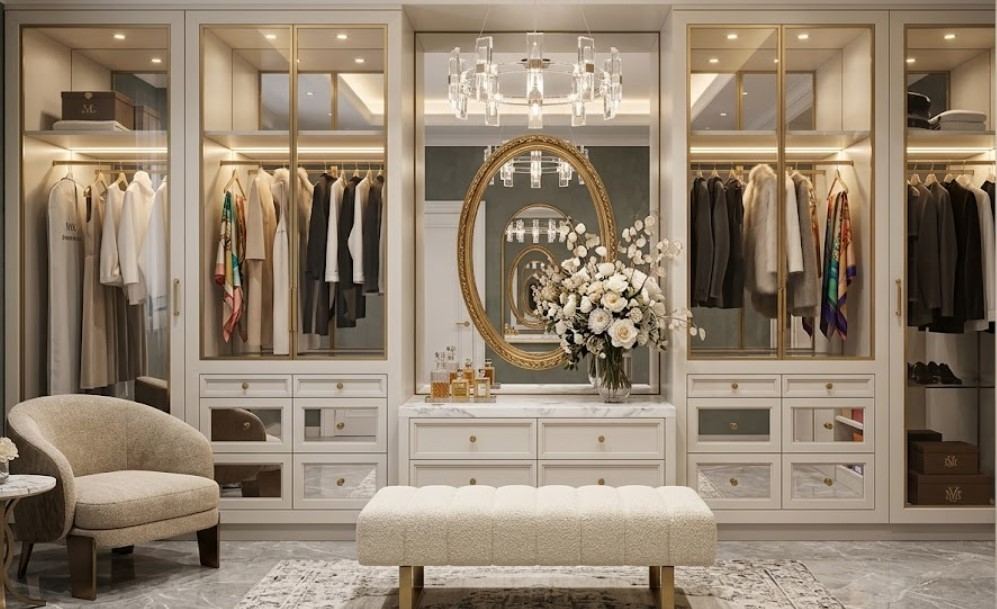
Choosing between custom mirrors and standard mirrors depends on your space, design requirements, budget, and desired finish. Standard mirrors are convenient and affordable, while custom mirrors provide precise sizing, greater design flexibility, and a better fit for unique interiors.
Understanding the difference can help you choose the right mirror for your home or commercial space.
What Are Custom Mirrors?
Custom mirrors are made according to specific measurements and design requirements. Unlike ready-made mirrors, they can be fabricated to suit the exact dimensions of a wall, vanity, wardrobe, niche, or feature area.
Custom cut mirrors can be produced in different shapes, including rectangular, round, oval, arched, and geometric designs. Depending on the project, homeowners can also consider different edge finishes, thicknesses, tints, frames, and installation options.
This makes custom mirrors in Dubai and the UAE suitable for modern villas, apartments, hotels, offices, retail spaces, bathrooms, dressing rooms, and other interiors where precise fitting matters.
What Are Standard Mirrors?
Standard mirrors are ready-made or prefabricated mirrors available in predetermined sizes and common shapes. They are widely available and generally require less planning than a made-to-measure mirror.
A standard mirror can be an excellent choice when an available size fits the wall or furniture correctly. They are commonly used in bedrooms, small bathrooms, dressing areas, rental properties, and simple decorative applications.
However, fixed dimensions can become a limitation when the available space has unusual measurements or when the mirror needs to work around lighting, cabinets, sockets, or other architectural elements.
Custom Mirrors vs Standard Mirrors: Key Differences
The main difference between custom and standard mirrors is flexibility. Custom mirrors are designed around the space, while standard mirrors require the space to accommodate an existing size.
| Feature | Custom Mirrors | Standard Mirrors |
| Size | Made to exact measurements | Fixed dimensions |
| Shape | Wide range of options | Common shapes |
| Fit | Precise | Depends on available size |
| Edge finish | More customization | Limited options |
| Design flexibility | High | Limited |
| Availability | Made to order | Usually ready-made |
| Installation | May require professional fitting | Generally simpler |
| Initial cost | Usually higher | Usually lower |
| Best for | Bespoke interiors | Simple applications |
1. Size and Fit
The size of a mirror can significantly affect the balance of an interior. A mirror that is too small may leave large empty areas, while an incorrectly positioned mirror can interfere with lighting, cabinets, or other features.
A custom mirror can be measured specifically for the installation area. This makes it useful for large wall mirrors, full-width bathroom vanities, wardrobes, alcoves, staircases, and walls with unusual dimensions.
For example, a wide bathroom vanity may look more cohesive with a made-to-measure mirror extending across the required width instead of using a smaller ready-made product.
2. Design Flexibility
Standard mirrors usually provide a limited selection of sizes, shapes, and finishes. Custom mirrors allow the design to be coordinated with the surrounding interior.
Depending on the project, custom options may include:
- Round, oval, square, and arched mirrors
- Custom dimensions
- Polished or beveled edges
- Framed or frameless designs
- Tinted mirror finishes
- Decorative mirror configurations
- Cut-outs for selected fixtures
This flexibility makes custom decorative mirrors suitable for feature walls, luxury interiors, dressing areas, hospitality projects, and contemporary residential spaces.
3. Custom Bathroom and Vanity Mirrors
Bathrooms are one of the most practical applications for custom mirrors. The mirror needs to work with the vanity, wall dimensions, lighting, backsplash, and overall interior design.
A custom bathroom mirror can be fabricated to match the width and proportions of a vanity. It can also be planned around specific lighting points or other fixed elements.
This is particularly useful for bathrooms with double vanities, wide countertops, unusual wall dimensions, or premium interior finishes.
When selecting a bathroom mirror, consider more than appearance. Moisture exposure, ventilation, installation method, and the quality of the mirror backing can all affect long-term performance.
4. Large Wall and Floor-to-Ceiling Mirrors
Mirrors are often used to make interiors appear brighter and more spacious. By reflecting light and surrounding surfaces, they can create greater visual depth.
Large wall mirrors are commonly used in living rooms, bedrooms, entrance areas, dressing rooms, gyms, hotels, restaurants, and commercial interiors.
A floor-to-ceiling mirror can create a particularly strong visual effect by extending the reflective surface vertically. However, large mirrors require careful measurement and professional handling because transportation, wall conditions, weight, and installation all need to be considered.
For this reason, custom fabrication is often more practical for large or complex installations.
5. Mirror Quality, Thickness and Durability
Mirror performance depends on factors such as glass thickness, reflective coating, protective backing, installation, and the environment where the mirror is used.
For example, bathroom mirrors are regularly exposed to humidity and condensation. Appropriate product selection and correct installation can help reduce the risk of deterioration around the edges.
Thickness should also be selected according to the mirror’s dimensions and intended application. A larger installation may have different requirements from a small decorative mirror.
Rather than choosing a mirror based only on thickness, consider the complete specification, installation method, and environment.
6. Custom Mirror Cost vs Standard Mirror Cost
One of the biggest differences between custom and standard mirrors is the initial price.
Custom mirrors generally cost more than standard mirrors because they require made-to-measure fabrication and may involve additional processing, finishing, transportation, or installation.
The overall cost can depend on:
- Mirror dimensions
- Glass thickness
- Shape
- Edge finishing
- Beveling
- Decorative treatments
- Frame requirements
- Quantity
- Transportation
- Installation complexity
A standard mirror can therefore provide better value when a ready-made size fits the space. A custom mirror may provide greater value when exact dimensions, specialized design, or a difficult installation area are involved.
The cheapest option is not always the most suitable option. The right choice should consider both upfront cost and the requirements of the finished space.
When Should You Choose a Custom Mirror?
A custom mirror is worth considering when you:
- Need an exact size
- Have an unusual wall or architectural opening
- Want a full-wall installation
- Need a floor-to-ceiling mirror
- Require a particular shape
- Want a custom vanity mirror
- Need cut-outs around fixtures
- Prefer a frameless architectural appearance
- Are creating a premium interior
- Need several mirrors with matching dimensions
For custom mirrors in UAE, professional measurement can be especially useful for large, heavy, or complex installations.
When Is a Standard Mirror Better?
A standard mirror can be the better choice when:
- You have a limited budget
- A ready-made size fits perfectly
- You need a mirror quickly
- The application is straightforward
- You are furnishing a rental property
- Advanced customization is unnecessary
For a simple bedroom, dressing area, or small bathroom, there may be little practical benefit in paying extra for customization if a standard mirror already meets the requirements.
How to Choose the Right Mirror for Your Space
Before choosing between a custom and standard mirror, consider five factors:
1. Measure the space: Check the available height and width before selecting a mirror.
2. Consider the application: Bathroom vanity mirrors, wardrobe mirrors, decorative mirrors, and large wall mirrors can have different requirements.
3. Evaluate the design: Decide whether you need a specific shape, edge finish, tint, frame, or frameless appearance.
4. Consider installation: Large or complex mirrors may require professional measurement, transportation, handling, and installation.
5. Compare total value: Look beyond the initial price and consider fit, appearance, functionality, quality, and expected use.
Custom Mirrors vs Standard Mirrors: Which Is Best?
There is no universal winner.
- Custom mirrors are generally the better option when precise fitting, design flexibility, unusual dimensions, or a premium finish are priorities.
- Standard mirrors are usually more suitable when affordability, convenience, and immediate availability matter most.
For bathrooms, large feature walls, wardrobes, dressing areas, luxury villas, hotels, and commercial interiors, custom mirrors can provide a more integrated result. For simple decorative or functional requirements, a standard mirror can be completely sufficient.
Conclusion
Choosing between custom mirrors and standard mirrors in Dubai depends on your space, design, and budget. Custom mirrors offer a precise fit and greater flexibility, while standard mirrors are a practical choice for simple applications.
Al Lamsah Al Shafafah provides custom glass and mirror solutions across Dubai, Sharjah, and the UAE, with options tailored to residential and commercial interiors.
Ready to upgrade your space with a custom mirror? Contact Al Lamsah today for expert guidance, quality fabrication, and a mirror solution made to fit your exact requirements.